Business

HVAC Answering Service Cost in 2026: What You Pay vs. What You Get

Human HVAC answering services cost $1.25–$2.50/minute or $400–$1,200/month — and they take messages, not bookings. Here's the full cost-vs-value breakdown, plus the free Revenue Leak Audit.

May 2, 2026
17 min read
hvac answering service costanswering service for hvachvac call center pricing

HVAC Answering Service Cost in 2026: What You Pay vs. What You Get

Editorial scale weighing a stack of paper message slips and a desk phone receiver against a modern smartphone with an AI voice waveform and confirmed appointment cards, on a wooden desk with blueprint-textured background
The headline cost of an HVAC answering service is rarely the real cost. The real cost is what the service doesn't catch.

You called three answering services last week and got three different quotes. One charges $89/month. Another quoted $1.50 per minute. The third pitched a full-service package at $900/month. None of them could tell you a straight answer to the question you actually care about: how many missed calls will you turn into booked jobs?

That's the question this article answers — by pricing every option in the market and then putting them all against the only metric that matters for an HVAC operation: cost per actually-booked appointment.

By the end of this article, you'll know the real per-minute, per-call, and per-month pricing of every type of HVAC answering service in 2026, the cost-per-booked-job comparison that exposes what's really going on, and the question to ask any vendor before you sign anything. Plus a free Revenue Leak Audit you can run on your own numbers in 60 seconds.


TL;DR

  • Per-minute human answering services: $1.25–$2.50/minute, per Service Direct's home-services cost reports and industry call-center benchmarks. Billing scales with call volume — so peak season triples your bill.
  • Flat-rate human answering services: $400–$1,200/month, depending on call volume and feature tier. Cheap tiers ($50–$150/mo) are essentially "better voicemail" — they take messages and email you.
  • Per-call human answering services: $4–$8 per call typical. Predictable per-incident but unbounded monthly cost.
  • AI answering services: Different pricing structure — outcome-based, not per-minute. Direct comparison done below on cost-per-booked-job, the only number that touches HVAC P&L.
  • Cost-per-booked-job math: A $700/mo human service that recovers 20% of missed calls costs ~$233 per booked job. An AI service recovering 55% of missed calls runs at a fraction of that — usually $40–$80 per booked job at typical HVAC volume.
  • The hidden cost nobody invoices for: 85% of unanswered HVAC callers never call back (Hiya 2024 State of the Call). Every answering service that operates on a message-relay model preserves the appearance of coverage while losing those calls.
  • Run yours: Free Revenue Leak Audit — 60 seconds, full PDF in your inbox.

The brutal sentence: The cheapest answering service on the market and the most expensive one both lose the same call — the one where the customer needed an answer in 45 seconds and got a message-taker in three minutes.


The Four Pricing Models You'll Actually See

When you call ten answering services for quotes, you'll get pricing in one of four structures. Each one has a built-in incentive problem worth understanding before you sign.

1. Per-Minute Pricing ($1.25–$2.50/min)

The dominant pricing model in the call-center industry, per Service Direct's lead-response-cost analysis and Smith.ai's published rate cards. Industry-wide, per-minute rates cluster between $1.25 and $2.50/minute for general business answering, with HVAC-specific or after-hours rates pushing the top end.

The math, applied to typical HVAC call patterns:

Call typeAvg durationCost per call
Quick message take1.5 min$1.88 – $3.75
Standard qualification3 min$3.75 – $7.50
Booking attempt + holds5 min$6.25 – $12.50
After-hours emergency triage7 min$8.75 – $17.50
That looks reasonable per call. The trap: billing scales with your call volume. A heat wave triples your inbound calls. Your bill triples too. So does your wait time per caller, because the service's own staffing didn't triple.

2. Flat-Rate Monthly ($50–$1,200/month)

The most common shopping pattern. Tiered packages, advertised at flat monthly rates with included-minute caps and overage charges:

  • Basic message-taking ($50–$150/month): Live human picks up, takes a message, texts or emails it to you. No booking. No scheduling. No emergency triage. Often business-hours only.
  • Standard virtual receptionist ($200–$600/month): Scripted qualification, some calendar access (usually a shared Google Calendar, not your live dispatch board), extended hours, optional 24/7 surcharge.
  • HVAC-specific or full-service ($600–$1,200/month): Operators trained on your company, after-hours coverage, configured emergency escalation, sometimes Spanish-language operators at extra cost.
The cheap tiers are the trap. A $79/month message-taking service preserves the appearance of always-on coverage while losing the same calls voicemail loses — because the homeowner still has to wait hours for an actual callback from you, and 85% of unanswered HVAC callers don't wait (Hiya 2024 State of the Call; Pew Research on declining voicemail use).

3. Per-Call Pricing ($4–$8 per call)

Less common but increasingly offered. You pay per inbound call answered, regardless of duration. Typical range from published industry data: $4–$8 per call.

Per-call models are predictable on the unit, unpredictable on the month. A 50-call week at $6/call = $300/week, $1,200/month — and unlike flat-rate plans, there's no ceiling.

4. AI Answering Services (Outcome-Based)

Purpose-built HVAC AI answering services run a different pricing model. There's no human-operator labor cost to mark up, so per-minute and per-call rates aren't the right framing. Instead, vendors price against the value created — recovered missed calls converted to booked appointments.

We don't publish Vectrion Core or Pro pricing on this page because the right tier depends on your call volume, average ticket, and current miss rate. The Revenue Leak Audit runs your specific numbers and surfaces the right tier in under 60 seconds.

What does matter: the cost-per-booked-job comparison. Which we run next.


The Cost-per-Booked-Job Comparison

Headline price isn't the right metric for an HVAC answering service. Cost per actually-booked job is — because that's the number that touches your P&L.

Here's the math on a mid-size shop missing 15 calls a week (a 40–50-call/week operation, 25–40% typical miss rate).

Scenario A: Basic Message-Taking Service ($79/month)

VariableValue
Monthly cost$79
Missed calls per week15
Recovery rate (message → callback → booked)~10%
Booked jobs per month~6.5
Cost per booked job~$12
Missed jobs per month at 78% bookable rate (HBR)~46
Annual revenue leaked at $425 ticket~$235,000
The per-booked-job cost looks great. The annual revenue leak is the actual story.

Scenario B: Full-Service Human Answering ($900/month)

VariableValue
Monthly cost$900
Missed calls per week15
Recovery rate (human callback inside hours, not minutes)~22%
Booked jobs per month~14
Cost per booked job~$64
Missed jobs per month at 78% bookable rate~37
Annual revenue leaked at $425 ticket~$189,000
Better recovery. Better per-booked-job cost. Still leaking near $200K/year because human callbacks happen in hours, not minutes — and 78% of callers book with the first responder (HBR analysis of 2,241 firms).

Scenario C: Per-Minute Service ($1.85/min average)

VariableValue
Avg call duration3.5 min
Cost per call answered$6.48
Calls answered per month (60% of inbound)~120
Monthly cost~$778
Recovery rate~18% (no proactive callback to missed calls)
Booked jobs per month~11
Cost per booked job~$71
Annual revenue leaked at $425 ticket~$200,000
The per-minute model has the additional problem that peak season — when your average ticket is highest (emergency calls, system failures) — is also when your bill spikes hardest. Cost variability shows up at exactly the wrong time.

Scenario D: AI Answering Service (60-Second Callback)

VariableValue
Recovery rate (sub-60-sec callback, Drift / Velocify benchmarks)45–55%
Booked jobs per month from missed calls~33
Cost per booked jobSignificantly lower than $64
Annual revenue leaked at $425 ticket~$56,000 (residual from non-converters)
Annual revenue recovered vs. scenario A~$179,000
The AI service doesn't just cost less per booked job. It books 3-5x more jobs off the same missed-call pool — because the callback window is 45 seconds instead of three hours.
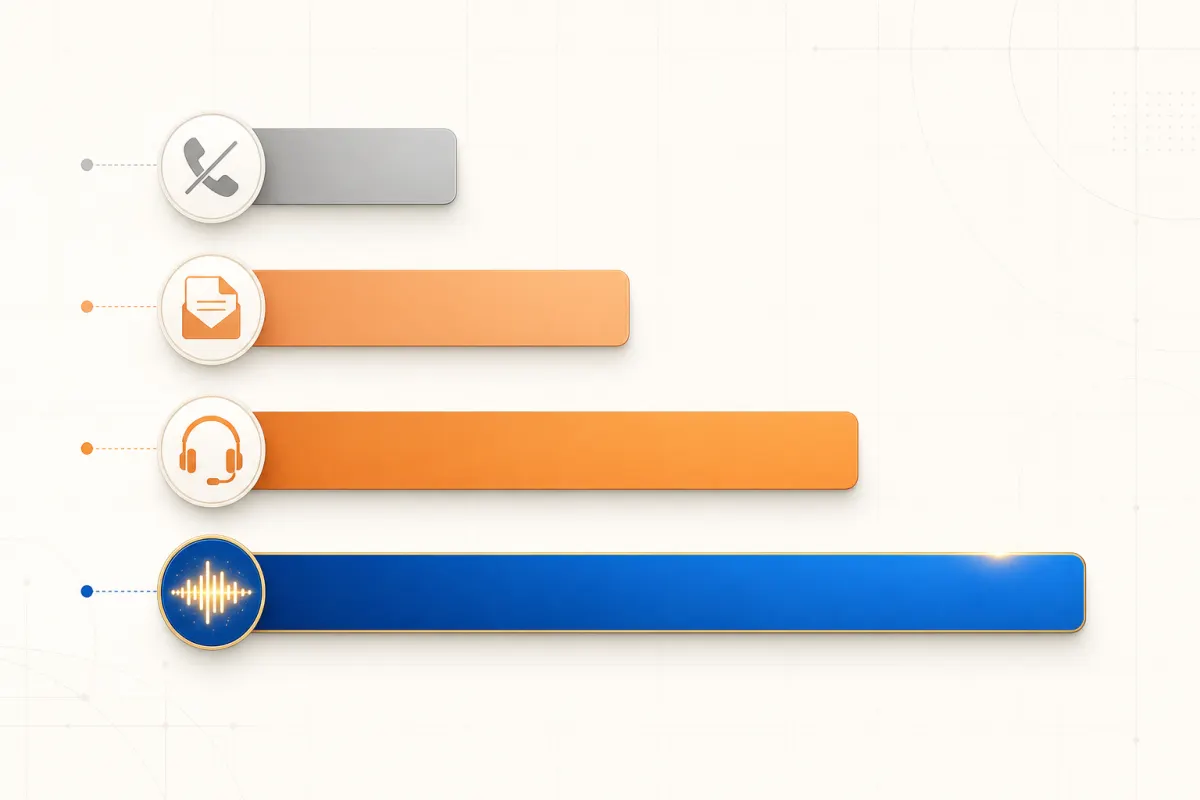
Comparison chart showing four answering service options as vertical bars: voicemail shortest, basic message service slightly longer, full human answering service medium, AI answering service longest with gold accent, each with an icon at the start indicating the type
Cost-per-booked-job comparison across HVAC answering service tiers. AI's edge comes from recovery rate, not headline price.

Voicemail: The Hidden $0 "Option"

Some HVAC owners skip answering services entirely and rely on voicemail. The cost is $0/month. The recovery rate, per Hiya's 2024 State of the Call and Pew Research's voicemail-behavior data, is approximately 15% — and that 15% is biased toward existing customers who already know your name. New leads almost never leave voicemails on service calls.

OptionMonthly costRecovery rateBooked jobs/mo @ 15 missed/wk
Voicemail only$0~15%~9
Basic message service ($79/mo)$79~10% (worse — false sense of coverage)~6.5
Full human answering ($900/mo)$900~22%~14
AI answering, sub-60-sec callbackOutcome-based45–55%~33
The dollar-zero voicemail option occasionally outperforms paid message-taking services because at least the homeowner knows immediately that no one is answering and can self-select to call back. The paid-message-service customer waits — and then doesn't call back. Both lose the call. Only one of them charges you for it.

For the full math on what voicemail-default operations actually cost annually, see our HVAC missed-call cost calculator — the scenario walkthroughs by company size make the cost concrete.


What Drives Human Answering Service Cost

Understanding why human answering services cost what they cost helps explain why their economics are structurally capped.

Labor cost is the floor

BLS Customer Service Representative wage data puts the median CSR wage at roughly $18.50/hour ($38,500/year fully employed). Trained call-center operators with HVAC-specific training and after-hours premium pay come in closer to $22–$28/hour fully loaded.

An operator handles roughly 10–12 calls per hour at average duration. That's a labor cost of $1.85–$2.80 per call before software, supervision, real estate, training, profit margin, or any overhead. Industry-standard markup on labor in the call-center vertical is 2.5–3.5x, which lands you at $4–$8 per call retail — exactly what the per-call models charge.

The labor math also explains why per-minute rates can't drop. A service offering $0.80/minute is losing money on every call longer than two minutes — which is most of them.

Peak-season demand is unservable

The U.S. Energy Information Administration tracks cooling-degree-day spikes that drive HVAC call-volume surges. A 7-day heat wave can triple inbound call volume overnight. No human-staffed answering service can triple its workforce in 24 hours. Result: longer hold times, dropped calls, lower booking quality — at exactly the moment your average ticket is highest.

This is the structural reason human services degrade in the seasons where you need them most.

After-hours premium is real and unavoidable

ACCA contractor surveys consistently show 35–55% of HVAC calls happen outside 9-to-5 weekday hours — evenings, weekends, before-work emergency calls, after-school heating failures. Human answering services either staff overnight (paying shift premium + training surcharge) or rotate to less-experienced overnight operators (recovery rates drop). Either way, after-hours quality is worse than business-hours quality at higher cost.

💡 The structural ceiling no human service can break: Service Direct's own data shows even premium HVAC-specific answering services book ~22% of after-hours missed calls. The remaining 78% are calls where the homeowner moved on before a human callback was possible. That's not an operator-quality issue. That's a clock-speed issue.


What to Actually Ask Before You Sign

Most HVAC owners ask the wrong questions when shopping answering services. Here's the list that actually matters.

1. What's your callback time from missed call to live operator dialing back?

Don't accept "we respond promptly." Get a number. Anything over 5 minutes is structurally non-competitive — HBR's data shows lead-qualification probability drops more than 80% past the 5-minute mark. Under 60 seconds is the benchmark. Most human services answer this honestly at 30–180 minutes.

2. Do you integrate directly with my dispatch software, or book into a separate calendar?

The answer determines whether you'll be manually re-entering appointments. The best AI services capture a structured handoff your dispatcher pastes in seconds (no free-text retyping); direct API booking is rolling out per dispatch platform. Most legacy services give you free-text only.

3. What's your published booking rate on calls answered?

A service that won't share this number is hiding something. Industry-good is 35–45% on inbound business-hours calls, much lower on after-hours. AI services routinely report 55–70%+.

4. How do you handle the 85% of callers who don't leave voicemail?

This is the test question that separates message-takers from actual recovery systems. If they don't have a proactive callback feature — where a missed call triggers an outbound dial to that number — they're not solving the missed-call problem. They're documenting it.

5. What's the all-in monthly cost in my third busiest month last year?

Per-minute and per-call models obscure peak-month cost. Ask for the calculation based on your actual seasonal call volume. The honest answer is often 2–3x the headline rate.

6. Can you read me a redacted transcript of a call you handled at 11 PM on a Saturday last month?

After-hours quality is where most services break. The redacted transcript request reveals the operator's actual scripting, qualification depth, and handoff quality — without violating customer privacy.

For a deeper read on response-speed economics and why the 5-minute mark is the real cliff, see The 47-Hour Problem — it explains what happens to leads while a message-taking service is still relaying messages.


When a Human Answering Service Still Makes Sense

To be honest about the trade-offs: there are HVAC situations where a human answering service remains the right pick.

  • Very low inbound call volume (<5 missed calls per week). The recovery-rate math doesn't justify AI infrastructure cost. A $79/month message service plus aggressive self-callback by the owner outperforms.
  • Highly complex commercial HVAC with multi-decision-maker procurement, RFP-driven sales cycles, or technical-spec discovery calls that need a knowledgeable human triaging from message one.
  • Regulated commercial contexts (hospitals, government facilities, certain industrial accounts) with documented vendor-management requirements that mandate human handling.
For residential HVAC contractors at $1M+ annual revenue with meaningful inbound call volume? The cost math has flipped. The question isn't whether to use AI — it's whether continuing to pay a human service to lose 75–85% of missed calls is still defensible against your competitor down the street who answers in 45 seconds.

The Real ROI Question

Forget headline cost. The decision question is this:

For every $1,000 you spend on an HVAC answering service, how many booked jobs do you get back, and at what average ticket?

Run it on your numbers:

  1. Pull your last 6 months of inbound call data (from your phone system or VoIP provider).
  2. Multiply missed-call count × 78% bookable rate × your average ticket.
  3. Apply realistic recovery rates: ~20% for human services, ~45–55% for AI sub-minute callback systems.
  4. The delta is your annual revenue opportunity. Compare that to the service cost. Decide.
The free Revenue Leak Audit does steps 1–3 in under 60 seconds and emails you the PDF.

Frequently Asked Questions

How much does an HVAC answering service cost in 2026? Human HVAC answering services typically cost $1.25–$2.50 per minute on per-minute plans, $400–$1,200 per month on flat-rate plans, and $4–$8 per call on per-call plans, per Service Direct's home-services cost reports and industry call-center benchmarks. Basic message-taking starts at $50–$150/month.

Why do HVAC answering services charge per minute? Per-minute pricing reflects the labor cost of live human operators. BLS data pegs median CSR wage at ~$18.50/hour; trained operators with HVAC-specific training and after-hours premium run $22–$28/hour fully loaded. Standard call-center markup is 2.5–3.5x labor, which lands the retail rate between $1.25 and $2.50/min.

Is an AI answering service cheaper than a human one for HVAC? On a per-minute basis, AI is significantly cheaper because there's no human labor in the loop. On the metric that actually matters — cost per booked job — AI is dramatically cheaper because recovery rates run 2–3x higher than human services. A human service at $900/month recovering 22% of missed calls runs ~$64/booked-job; AI services routinely beat that by 2-4x.

What's wrong with a $50/month basic answering service? The cost looks great. The recovery is worse than voicemail. 85% of callers don't wait for callbacks, and a message-taking service preserves the appearance of coverage while losing the same calls voicemail would lose — the only difference being you're now paying $50/month for the false reassurance.

Do answering services integrate with ServiceTitan, Housecall Pro, or Jobber? Most human answering services book into a shared Google Calendar or similar tool you sync separately — not your live dispatch board. This creates double-booking risk, manual sync work, and incomplete customer records. Purpose-built AI answering systems capture structured booking details for your dispatcher to paste in seconds (today), with direct API integration rolling out per platform — Housecall Pro and Jobber first via public OAuth, ServiceTitan and FieldEdge requiring partner certification. Ask any vendor for a current capability list before assuming "direct write."

How do I calculate the real cost of an HVAC answering service? Three lines: (1) the invoice — monthly base + overage, (2) opportunity cost of calls the service misses or fails to book, and (3) the slow-callback penalty on the recovered-but-unconverted leads. Most owners only measure line 1. Full cost typically runs 3–5x the invoice once you add lines 2 and 3 against your average ticket. Run yours with the free Revenue Leak Audit.


The Bottom Line

In 2026, HVAC answering services span a 20x range on headline price — from $50/month message-taking to $1,200/month full-service plus per-minute overage. On cost per booked job, that 20x compresses to about 3–5x, because what you're really buying is recovery rate.

And on recovery rate, the gap between the best human answering service and a purpose-built AI answering service is the difference between losing $200,000/year and losing $50,000/year — at the same call volume, same average ticket, same business.

The cheapest answering service in 2026 is the one that books the most jobs per dollar. That ranking shuffles depending on your call volume and average ticket, but the math is computable in 60 seconds against your actual numbers.

Next step: Run the free Revenue Leak Audit on your own numbers — 60 seconds, no sales call, full PDF breakdown in your inbox.


Related reading:

Ready to stop losing leads?

Takes 60 seconds to fill out. We'll email your full revenue leak report in under 2 minutes.

No obligation. No credit card. Your Revenue Leak Report arrives in under 2 minutes.

AI receptionist live
📞 (866) 551-4724Hear our AI now